
Knowledge Base · Category 1
Short introduction
iTrain TLSPilot is an agentless Certificate Lifecycle Management solution for managing TLS certificates across your infrastructure. Your license covers the TLSPilot software, while the certificates themselves come from the sources you choose: internal issuers such as your Enterprise CA (AD CS) or the built-in Private CA, and public ACME providers that you enable.
Chapter overview
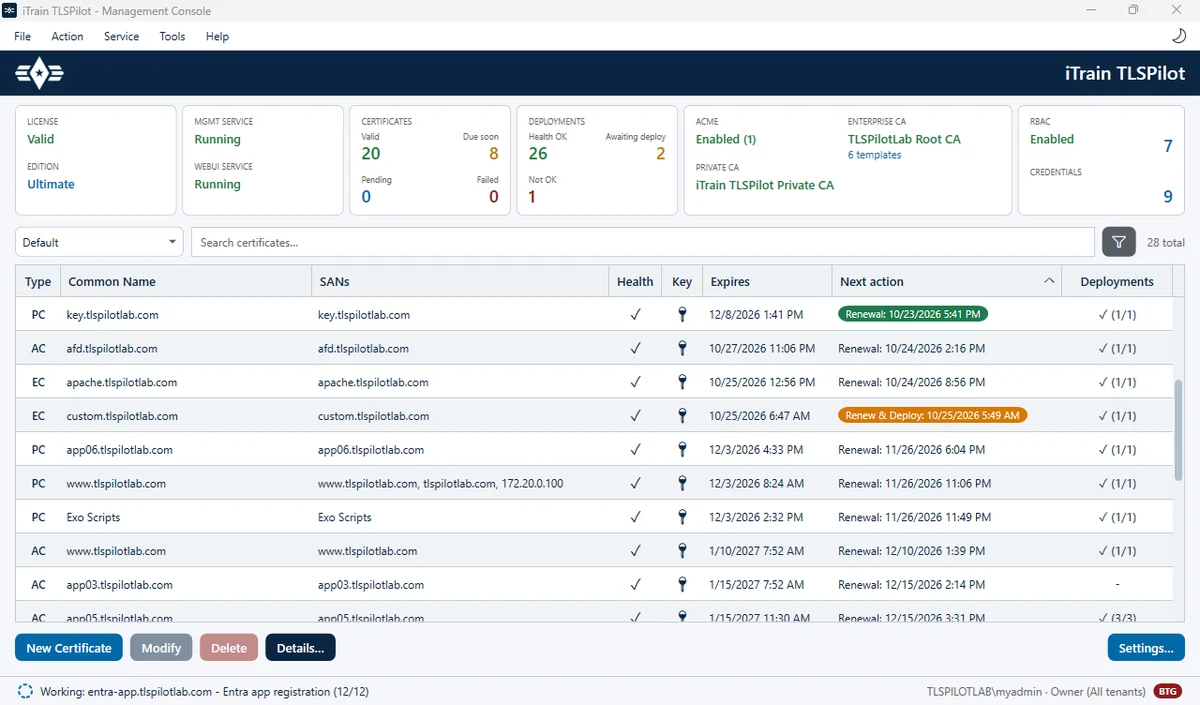
What TLSPilot does for you:
- Issuance and renewal: Obtains and renews certificates from your internal issuers and public ACME providers.
- Lifecycle tracking: Tracks each certificate from issuance through renewal and revocation, with a complete history.
- Agentless deployment: Deploys each certificate to one or more targets, where it writes and binds the leaf certificate without installing agents.
- Health monitoring: Regularly verifies that each certificate is present on its target and correctly bound.
- Automated operations: Runs a daily cycle and provides alerting, audit logging, and backup.
- Two consoles: Provides the Desktop Admin console and the WebUI, which follow the same structure and behavior.
What TLSPilot does not do:
- Certificate sales: Does not sell certificates. They are issued by your internal CAs or by the ACME providers you enable.
- Service configuration: Does not create websites or virtual hosts on target systems. Certificates are deployed to existing configurations.
- Multi-tier PKI: Does not operate a multi-tier PKI hierarchy. The built-in Private CA is a single root CA that issues leaf certificates directly.
- Cloud service: Does not run as a SaaS portal. TLSPilot, including the WebUI when licensed, runs entirely on your own management host.
- Continuous monitoring: Does not monitor certificates continuously. They are checked during the daily cycle, after each deployment or on demand.